Hi all,
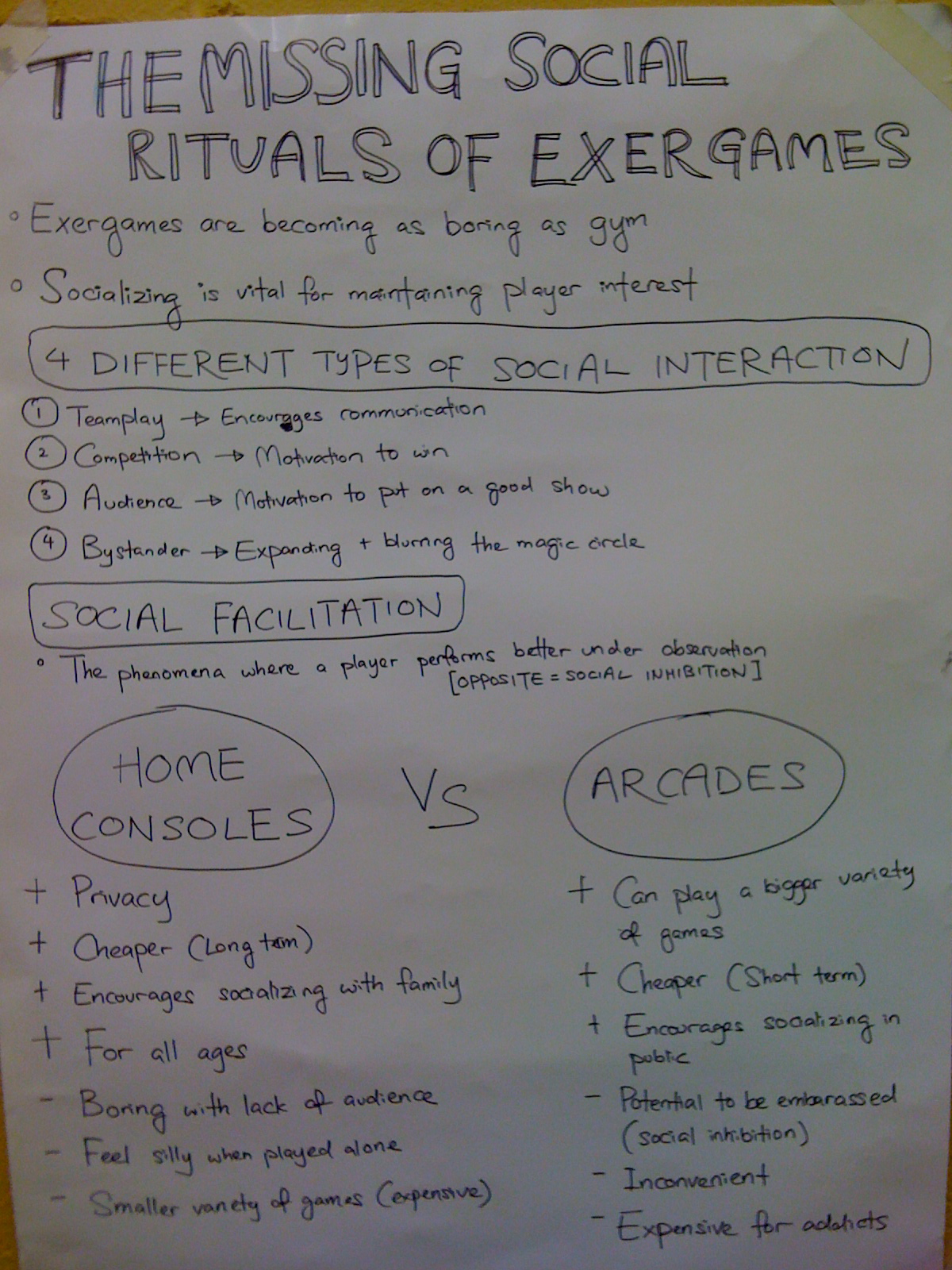
Thanks for joining tonight. During this lecture, you saw how all your hard work on the presentations and the posters came together to help you in your career when it comes to talk about and analyze games such as Guitar Hero or the bar game. You have also seen how the theoretical work from the various game academics worldwide you were exposed to during this semester can support you in your quest to create more awesome games.
I am looking forward to playing your game next week!
Homework:
* 1 exertion game without a conventional screen
* 1 website that describes the game and its benefits (example see pacmanhattan)
* 1 video on youtube
* promotional photograph (collage)
** 1024x768 landscape
** gametitle
** 1-2 sentences describing how the game works and why we need it
** URL
** team
* Promote demo night
* Bring cameras etc
* Report red dots at end of demo night
* Return hardware at end of demo night
Please post in the blog any feedback you might have on the use of the design dimensions in you creating your upcoming game (or any other games where you might have used (any) dimensions).
Thursday, May 20, 2010

Wednesday, May 19, 2010

Thursday, May 13, 2010


The difference between Microsoft's Natal and Nintendo's Wii for game designers: Again
Please post here in the comments (bullet points please) what the difference is for you as game designers between the technology behind Microsoft's Natal and Nintendo's Wiimote (Plus).
Can you think of a game that you can design with one, but not with the other?
Use the language from the posters in class and the design dimensions.
So far:
- Wii: expands the magic circle by supporting social play between players who cannot see each other, i.e. cannot anticipate their next moves
- Natal: supports tactics such as offense and defense in the physical space (i.e. players pushing each other to gain an advantage), as technology can distinguish body positions relative to one another
Can you think of a game that you can design with one, but not with the other?
Use the language from the posters in class and the design dimensions.
So far:
- Wii: expands the magic circle by supporting social play between players who cannot see each other, i.e. cannot anticipate their next moves
- Natal: supports tactics such as offense and defense in the physical space (i.e. players pushing each other to gain an advantage), as technology can distinguish body positions relative to one another
Lecture 10: 13May2010 The Mousegrip and Pushing Pixels
Hi all,
Thanks for joining tonight.
Today you have seen how to make an Exertion Game for <$15. You have also experienced an Exertion Game that allows asynchronous interaction. Supporting asynchronous interaction is one big reason why computers can offer different experiences beyond what we already know from sports.
Again, thanks for filling out the survey form, it is truly appreciated. And thanks Seph for taking care of them.
Homework for next week:
* Blog: a) Comment on the lecture OR b) repeat the most important point you have learned for those who could not attend OR c) describe the difference between Wii and Natal for designers AGAIN, IN A NEW AND SEPARATE BLOG ENTRY
* Report progress on your team website/blog
* Promote demo night on facebook, twitter, etc. Invite friends, companies you want to work for, the press (remember, everyone gets dots)
* Start working on your video, promotional picture and website for your game
Thanks for joining tonight.
Today you have seen how to make an Exertion Game for <$15. You have also experienced an Exertion Game that allows asynchronous interaction. Supporting asynchronous interaction is one big reason why computers can offer different experiences beyond what we already know from sports.
Again, thanks for filling out the survey form, it is truly appreciated. And thanks Seph for taking care of them.
Homework for next week:
* Blog: a) Comment on the lecture OR b) repeat the most important point you have learned for those who could not attend OR c) describe the difference between Wii and Natal for designers AGAIN, IN A NEW AND SEPARATE BLOG ENTRY
* Report progress on your team website/blog
* Promote demo night on facebook, twitter, etc. Invite friends, companies you want to work for, the press (remember, everyone gets dots)
* Start working on your video, promotional picture and website for your game
HealthGamers.com report about Exertion Games demo night and class
An interview on HealthGamers.com about the Exertion Games demo night and the class and students, with all the links included!
Thursday, May 6, 2010
The difference between Microsoft's Natal and Nintendo's Wii for game designers
Please post here in the comments (bullet points are fine, but be precise!) what the difference is for you as game designers between the technology behind Microsoft's Natal and Nintendo's Wiimote.
What can you do with one that you cannot do with the other?
I challenge you that there is only a handful of points, but that they are much more important than 'more limbs'.
What can you do with one that you cannot do with the other?
I challenge you that there is only a handful of points, but that they are much more important than 'more limbs'.
Lecture 9: 06May2010 The Mind and the Body
Hi all,
Thanks again for coming out tonight.
Today you learned about what we know about the body (or how little about it), and how our interactions with computers (not just computer games) are becoming more and more appreciative of the physics of the real world. This is particularly buoyant in games, but can also be observed in how the iPhone adds weight to contacts, for example (You could push that further by 'adding' extra weight to 'heavy' - equals more important - contacts, so they come up more prominent when you flick through with your finger).
In order to design for the body, the best advice so far (to be most effective) is therefore probably no to think, but DO. Designing for the body means moving the body, and you hopefully have seen how the tape-body-parts-together might have given you ideas that would be a million times more complex to imagine and describe with the mind.
I realized that I did not let enough people speak who have not said enough yet, so sorry about that, I'll try to be better next time.
Homework for next week:
* Blog: a) Comment on the lecture OR b) repeat the most important point you have learned for those who could not attend OR c) describe the difference between Wii and Natal for designers IN THE SEPARATE BLOG ENTRY
* Report progress on your team website/blog
* Read the reading assignments for next week
* If you have not done so, email me your dots, video and promotional pic
PS: For the rock-climbing team: Have you thought why you are trying to 'improve' rock-climbing? Are you improving it? If so, why? Or are you making it more accessible? Or more engaging? What do you tell a rock-climber who might say: but rock-climbing is great on its own? Why do we need to add computers?
PPS: A note on getting in the paper: try to market your game through facebook, twitter etc. Email your video out. You have no idea how many people would like to pass your game video to their friends rather than do work in the morning. Just ask all your facebook friends to send it to their friends (this is not spamming, as they should only do it if they like it). Tag the video properly. Increase the hit count. Tell people what they should write about: This game gets fat kids off the couch because ...
PPPS: Thinking about a tag line for any newspaper article might also help your game: If a reporter asks you, what should be the headline? What would you say? Why do we need your game? This is were a target-group might come in handy: Your game might get kids active who so far only liked computer games. Or create a game that takes the piss out of the Myki system: You would need to swipe a fake card a 100 times in order to get a score.... any topical statement is always great for the paper. Or make a game for the unemployed Storm players. Think of a headline: would you print it? If so, your game is on the right track.
And then send it to all the papers, blogs, online articles you know: they all have email addresses, twitter accounts etc. Hey, you have seen what they show on TV (especially shows like Sunrise etc), and they are asking in any of these shows to send in any news, so make use of this! Be an active citizen!
PPPPS: To the Bubble Popper team: Sorry if I might seem very pushy for you to create something new, but I have been thinking a lot why I would like to see this: I think it is a) because I see potential. Everyone enjoyed playing your game. It was simple but wonderful at the same time. Your game did not have a tag-line though (it did not 'help' anyone, did not make the world a better place, but it was so obvious 'fun'). But maybe it did not need one. Nobody also needed to think why this game needed a computer. It was clearly a computer game. You could not do it without a computer. And then I realized: Maybe it is b) I would like to see if you could pull this off again, i.e. do you have enough knowledge about games to do it again but with a different game or was it just mere luck? :-)
Thanks again for coming out tonight.
Today you learned about what we know about the body (or how little about it), and how our interactions with computers (not just computer games) are becoming more and more appreciative of the physics of the real world. This is particularly buoyant in games, but can also be observed in how the iPhone adds weight to contacts, for example (You could push that further by 'adding' extra weight to 'heavy' - equals more important - contacts, so they come up more prominent when you flick through with your finger).
In order to design for the body, the best advice so far (to be most effective) is therefore probably no to think, but DO. Designing for the body means moving the body, and you hopefully have seen how the tape-body-parts-together might have given you ideas that would be a million times more complex to imagine and describe with the mind.
I realized that I did not let enough people speak who have not said enough yet, so sorry about that, I'll try to be better next time.
Homework for next week:
* Blog: a) Comment on the lecture OR b) repeat the most important point you have learned for those who could not attend OR c) describe the difference between Wii and Natal for designers IN THE SEPARATE BLOG ENTRY
* Report progress on your team website/blog
* Read the reading assignments for next week
* If you have not done so, email me your dots, video and promotional pic
PS: For the rock-climbing team: Have you thought why you are trying to 'improve' rock-climbing? Are you improving it? If so, why? Or are you making it more accessible? Or more engaging? What do you tell a rock-climber who might say: but rock-climbing is great on its own? Why do we need to add computers?
PPS: A note on getting in the paper: try to market your game through facebook, twitter etc. Email your video out. You have no idea how many people would like to pass your game video to their friends rather than do work in the morning. Just ask all your facebook friends to send it to their friends (this is not spamming, as they should only do it if they like it). Tag the video properly. Increase the hit count. Tell people what they should write about: This game gets fat kids off the couch because ...
PPPS: Thinking about a tag line for any newspaper article might also help your game: If a reporter asks you, what should be the headline? What would you say? Why do we need your game? This is were a target-group might come in handy: Your game might get kids active who so far only liked computer games. Or create a game that takes the piss out of the Myki system: You would need to swipe a fake card a 100 times in order to get a score.... any topical statement is always great for the paper. Or make a game for the unemployed Storm players. Think of a headline: would you print it? If so, your game is on the right track.
And then send it to all the papers, blogs, online articles you know: they all have email addresses, twitter accounts etc. Hey, you have seen what they show on TV (especially shows like Sunrise etc), and they are asking in any of these shows to send in any news, so make use of this! Be an active citizen!
PPPPS: To the Bubble Popper team: Sorry if I might seem very pushy for you to create something new, but I have been thinking a lot why I would like to see this: I think it is a) because I see potential. Everyone enjoyed playing your game. It was simple but wonderful at the same time. Your game did not have a tag-line though (it did not 'help' anyone, did not make the world a better place, but it was so obvious 'fun'). But maybe it did not need one. Nobody also needed to think why this game needed a computer. It was clearly a computer game. You could not do it without a computer. And then I realized: Maybe it is b) I would like to see if you could pull this off again, i.e. do you have enough knowledge about games to do it again but with a different game or was it just mere luck? :-)
Monday, May 3, 2010
If you are in Sydney this Sat....
Janine from Demo Night invites you along:
http://sydsgbc.eventbrite.com/
http://sydsgbc.eventbrite.com/
Sunday, May 2, 2010
Friday, April 30, 2010
Lecture 8: 29Apr2010 Tangibility in Games
Today you learned about tangibility in games, and what characteristics of tangibility you can use in your game to what effects, as well as a lot about casual games and why they benefit from a social approach through social facilitation.
One aspect that should be added to the idea of tangibility is the opportunity to personalize your tangible object: for example, your guitar in guitar hero can be personalized with stickers, you can buy a better-looking plastic guitar etc. just to make you look even more like a rock-star, to support the fantasy effect of becoming a rock-star the game facilitates. You don't really have this opportunity for personalization with Natal.
And thanks for all your comments on the survey sheet! Here is already one change (I hope you like it):
Please comment on the blog what you think about casual games, tangibility and social play.
If your opinion has already been voiced, why don't you repeat the most important point (1 is enough) you have learned so that the people who weren't in have an easy way to catch up?
Homework for next week:
* Blog: See above
* Report progress on your team website/blog
* Read the reading assignments for next week
Thursday, April 29, 2010
Saturday, April 24, 2010
Fwd: Interesting video about games
I recently came across this Frontline (a Public Broadcasting Service program from the USA) episode about the digital world. About the last 15-20 minutes are focused on games.
Thought you might be interested.http://video.pbs.org/video/1402987791/#
Thursday, April 22, 2010
Lecture 7: 22Apr2010 Design Dimensions for Exertion Games
Today you learned about Design Dimensions for Exertion Games, and how playing with them can (hopefully) turn a great game idea into an awesome one!
For example, you have seen how adding a line (virtual or physical) in the Bubble Popper game could have made it a game solely about "being faster than the other player". In its current form, it is about "preventing the other player from scoring" by pushing the other player out of the way, a very different play experience (all of a sudden you can play offensively or defensively)! And by having the players hit one big target together (such as killing one big monster), the game could be turned into a collaborative affair, all without changing any technology! (What you could also do is point the projector at the people's bodies: now the balloon appears on your arm, and you can decide whether you will hit your own arm, or try to move it away so that the other player cannot hit it: can you see how your game now becomes more like Karate, changing the conceptual location in the design space again?)
Design Dimensions for Exertion Games
Thanks again for joining me today and giving me such great feedback! Your time and effort is appreciated.
I will look at all your feedback diligently and take it on board! See you next week!
Homework for next week:
* Blog: How (if) the dimensions helped you
* Send me video + photo (a 1024x768 photo with game title, 1 sentence gameplay, URL, team) before Tuesday
* Email me a picture of your dots
* Start working on your game
* Report progress on your website
PS: Biker-team: did you see the pump idea from one of the other teams? You could combine your games!
PPS: I just thought of another example where "secondary performance" is rewarded by the game: in Guitar Hero, if you lift the guitar up, you get extra points: the designers wanted to make sure you 'perform' like a rock star, so they linked this "secondary performance" aspect to the score, making it more interesting for the other players and the audience, and also getting you more bodily engaged. You can do the same in any game: if your player finished, and lifts up the arms in triumph, she/he gets extra points! A loud winning chant even more points!
For example, you have seen how adding a line (virtual or physical) in the Bubble Popper game could have made it a game solely about "being faster than the other player". In its current form, it is about "preventing the other player from scoring" by pushing the other player out of the way, a very different play experience (all of a sudden you can play offensively or defensively)! And by having the players hit one big target together (such as killing one big monster), the game could be turned into a collaborative affair, all without changing any technology! (What you could also do is point the projector at the people's bodies: now the balloon appears on your arm, and you can decide whether you will hit your own arm, or try to move it away so that the other player cannot hit it: can you see how your game now becomes more like Karate, changing the conceptual location in the design space again?)
Design Dimensions for Exertion Games
Thanks again for joining me today and giving me such great feedback! Your time and effort is appreciated.
I will look at all your feedback diligently and take it on board! See you next week!
Homework for next week:
* Blog: How (if) the dimensions helped you
* Send me video + photo (a 1024x768 photo with game title, 1 sentence gameplay, URL, team) before Tuesday
* Email me a picture of your dots
* Start working on your game
* Report progress on your website
PS: Biker-team: did you see the pump idea from one of the other teams? You could combine your games!
PPS: I just thought of another example where "secondary performance" is rewarded by the game: in Guitar Hero, if you lift the guitar up, you get extra points: the designers wanted to make sure you 'perform' like a rock star, so they linked this "secondary performance" aspect to the score, making it more interesting for the other players and the audience, and also getting you more bodily engaged. You can do the same in any game: if your player finished, and lifts up the arms in triumph, she/he gets extra points! A loud winning chant even more points!
Thursday, April 15, 2010
Demo night!!! Exertion Games that make the players physically exhausted
Tonight was demo night, and we saw many new computer game inventions that require players to invest physical effort (think of all the health benefits!) way beyond what Wii offers!
Who would have thought that working out could be so much fun?
Three hours of pure play! I hope you all had a
great time and exerted yourself. Congratulations to all of you for
making this night such a success!
In the comments you have the chance to congratulate those who you
didn't get a chance yet to tell what a great job they did!
Thanks also to our guests from Future Journeys, Exergaming Australia, 2nd years, and everyone else who helped making this a great night.


Please add your game's video here and make sure your webpage has a full description of your game for everyone to see. I would like to create a slideshow of all your games (like last year), so please add a promotional picture about your project here (either login yourself here or send me the URL).
Also, if you have not done so yet, please email me a picture of your dots (we had two late visitors who gave all their dots to Nick because he sticked around, so well done Nick!)
I was very impressed by the fact how you took the things you learned into your games: you looked at how people use their bodies and analyzed what makes bodily movements fun (see Kane's observations of 15-year-olds playing DDR) and how you expanded the magic circle socially (I am not sure if Luke would have "designed for an audience" (as he said) before he started this class) and environmentally (see escalator game).
You also focused on the game experience more than on the technology, even though you had some very clever implementation (you-have-to-run-for-the-music game, bubble-pop gloves) ideas which hopefully made you aware that you now can design anything you ever wanted!
And you all learned how to present your game idea in a busy, intense, and fast-paced environment, perfect for your future game pitches in industry!
Here are some individual comments about your games, as some of you asked me how they can improve. Here is what I saw (I am making up names for them based on what comes to my head first to show you what 'sticked'):
Balloon outdoor running game: I really like the idea of putting the exertion outside. Very similar to the other running games though. The video could have been even more convincing if it would have been 'real' people playing it, as in random people of the street. Nice use of phones!
Bubble popping: great fun, excellent use of social bodily interaction! Awesome simple game implementation. Next time make sure the room is really empty. Needs more audio effects (but not much else). you probably noticed that everyone who played it loved it, so kudos. But some people were reluctant to join in the first place, why? Are you getting in the paper?
music-running-music game: great idea of making people run based on sound (scream). wonderful simple implementation idea. You can make it more stable using an arduino and an accelerometer. Can't wait to try it out against another people.
bike: wonderful video. all you have to do is implement it, so I can play it! Is GPS going to be good enough? You could also combine it with an idea I had for a bike-version of Jogging over a Distance, but never implemented: Your cyclists should know _while_ cycling how far ahead their opponent is, not just at the end, at home in front of the computer. They cannot look at their mobile all the time for status updates, BUT they could have an attachment on their bike that has a laser pointer that is attached to a servo-motor that indicates how far ahead the other person is: the laser dot moves further or closer ahead of you on the street, controlled by the motor that moves the laser pointer up or down, indicating where the other cyclist is in relation to you (a little bit like the laser bike lane, but interactive). I have all the hardware for this, talk to me if you want to implement this.
bar game: great idea, I've said it before! Nice social add-on. Make it happen and bring the bar in so that people can try it! Get it connected with the Sydney lab! Good idea to involve hand-slapping as well.
Swimming: great idea of making swimming a 'spectacle', nice contrast to traditional swimming. Also nice consideration of social aspect. Well designed for the audience as well through glasses and body style. you obviously tried out many different movements and found one that is very exhausting very quickly. screen and game was a little bit 'conventional'. Great use of combining various body movements: swimming and turning.
Hunter: wonderful video, great editing. would have been even better if 'real' people would have been recorded (with permission) (see above). You can easily implement that on an iphone and give it to people. Well done on sticking around and demoing it to people.
punch willy: great combination of cognitive and bodily skills. wonderful clever implementation. needs projection and scoring system (processing with ess?). Did you think about social aspects? Can you put it int people's canteens as stress-relief?
Nymphora: great idea of 2 unequal participators: one runs, the other directs. would have liked to play it with others, and seen use of the punching video stuff. Would be great fun outdoors running around breaking the magic circle.
Escalator: great idea, very exhausting. nice example of designing for a specific target group: anarchists :-). Great video and logo. as mentioned, game device could easily give audio feedback and be wireless with wiimote. Think how computers could enhance it further: what could they do beyond counting rounds (which you can do in your head?). can you expand magic circle further by including by-standers? what about unaware participants? Great idea to get people away from classroom-style games.
Water bomb: nice idea of "fluid movement" combined with cooling down, which is important for exertion. How could computers improve this further? Why do you like _computer_ games? Can you get the 'cooling' and 'fluid movement' effect together with the advantages of computer gaming? Video with subtitles would look great on youtube.
Fencing: great job in considering the people and fantasy factor, adding a costume turned the game into a spectacle for the audience to enjoy also. For the code, you could just use the code the escalator guys have! It would be great if you could think of other advantages the technology offers: could, for example, a kid play with his dad/mum equally? Nice job in letting me win!
Achieve task in time and document with mobile: nice idea of challenging people with different capabilities and preferences. Already discussed ways to automate it, through making task recording colours, for example, and then analyzing them pro grammatically. Someone said she was not exerting much though?! How can technology facilitate that more? Think about hard fun & people factor!
Ball throwing: Lots of people loved it! Very exhausting. Nice job on going back to the basics: what is fun? nice video documenting how you tried out several approaches. Good idea having black and video targets. How could computers enhance the interaction? Could the lights go out after a certain while? Could people play in different time zones? Great website on documenting it! Can't wait for the video.
PS: All location-based games: Check this out: http://www.girardin.org/fabien/catchbob/pervasive/
Ok, that's from me, let me know if you need more feedback, can't wait to see your second games!
Who would have thought that working out could be so much fun?
Three hours of pure play! I hope you all had a
great time and exerted yourself. Congratulations to all of you for
making this night such a success!
In the comments you have the chance to congratulate those who you
didn't get a chance yet to tell what a great job they did!
Thanks also to our guests from Future Journeys, Exergaming Australia, 2nd years, and everyone else who helped making this a great night.


Please add your game's video here and make sure your webpage has a full description of your game for everyone to see. I would like to create a slideshow of all your games (like last year), so please add a promotional picture about your project here (either login yourself here or send me the URL).
Also, if you have not done so yet, please email me a picture of your dots (we had two late visitors who gave all their dots to Nick because he sticked around, so well done Nick!)
I was very impressed by the fact how you took the things you learned into your games: you looked at how people use their bodies and analyzed what makes bodily movements fun (see Kane's observations of 15-year-olds playing DDR) and how you expanded the magic circle socially (I am not sure if Luke would have "designed for an audience" (as he said) before he started this class) and environmentally (see escalator game).
You also focused on the game experience more than on the technology, even though you had some very clever implementation (you-have-to-run-for-the-music game, bubble-pop gloves) ideas which hopefully made you aware that you now can design anything you ever wanted!
And you all learned how to present your game idea in a busy, intense, and fast-paced environment, perfect for your future game pitches in industry!
Here are some individual comments about your games, as some of you asked me how they can improve. Here is what I saw (I am making up names for them based on what comes to my head first to show you what 'sticked'):
Balloon outdoor running game: I really like the idea of putting the exertion outside. Very similar to the other running games though. The video could have been even more convincing if it would have been 'real' people playing it, as in random people of the street. Nice use of phones!
Bubble popping: great fun, excellent use of social bodily interaction! Awesome simple game implementation. Next time make sure the room is really empty. Needs more audio effects (but not much else). you probably noticed that everyone who played it loved it, so kudos. But some people were reluctant to join in the first place, why? Are you getting in the paper?
music-running-music game: great idea of making people run based on sound (scream). wonderful simple implementation idea. You can make it more stable using an arduino and an accelerometer. Can't wait to try it out against another people.
bike: wonderful video. all you have to do is implement it, so I can play it! Is GPS going to be good enough? You could also combine it with an idea I had for a bike-version of Jogging over a Distance, but never implemented: Your cyclists should know _while_ cycling how far ahead their opponent is, not just at the end, at home in front of the computer. They cannot look at their mobile all the time for status updates, BUT they could have an attachment on their bike that has a laser pointer that is attached to a servo-motor that indicates how far ahead the other person is: the laser dot moves further or closer ahead of you on the street, controlled by the motor that moves the laser pointer up or down, indicating where the other cyclist is in relation to you (a little bit like the laser bike lane, but interactive). I have all the hardware for this, talk to me if you want to implement this.
bar game: great idea, I've said it before! Nice social add-on. Make it happen and bring the bar in so that people can try it! Get it connected with the Sydney lab! Good idea to involve hand-slapping as well.
Swimming: great idea of making swimming a 'spectacle', nice contrast to traditional swimming. Also nice consideration of social aspect. Well designed for the audience as well through glasses and body style. you obviously tried out many different movements and found one that is very exhausting very quickly. screen and game was a little bit 'conventional'. Great use of combining various body movements: swimming and turning.
Hunter: wonderful video, great editing. would have been even better if 'real' people would have been recorded (with permission) (see above). You can easily implement that on an iphone and give it to people. Well done on sticking around and demoing it to people.
punch willy: great combination of cognitive and bodily skills. wonderful clever implementation. needs projection and scoring system (processing with ess?). Did you think about social aspects? Can you put it int people's canteens as stress-relief?
Nymphora: great idea of 2 unequal participators: one runs, the other directs. would have liked to play it with others, and seen use of the punching video stuff. Would be great fun outdoors running around breaking the magic circle.
Escalator: great idea, very exhausting. nice example of designing for a specific target group: anarchists :-). Great video and logo. as mentioned, game device could easily give audio feedback and be wireless with wiimote. Think how computers could enhance it further: what could they do beyond counting rounds (which you can do in your head?). can you expand magic circle further by including by-standers? what about unaware participants? Great idea to get people away from classroom-style games.
Water bomb: nice idea of "fluid movement" combined with cooling down, which is important for exertion. How could computers improve this further? Why do you like _computer_ games? Can you get the 'cooling' and 'fluid movement' effect together with the advantages of computer gaming? Video with subtitles would look great on youtube.
Fencing: great job in considering the people and fantasy factor, adding a costume turned the game into a spectacle for the audience to enjoy also. For the code, you could just use the code the escalator guys have! It would be great if you could think of other advantages the technology offers: could, for example, a kid play with his dad/mum equally? Nice job in letting me win!
Achieve task in time and document with mobile: nice idea of challenging people with different capabilities and preferences. Already discussed ways to automate it, through making task recording colours, for example, and then analyzing them pro grammatically. Someone said she was not exerting much though?! How can technology facilitate that more? Think about hard fun & people factor!
Ball throwing: Lots of people loved it! Very exhausting. Nice job on going back to the basics: what is fun? nice video documenting how you tried out several approaches. Good idea having black and video targets. How could computers enhance the interaction? Could the lights go out after a certain while? Could people play in different time zones? Great website on documenting it! Can't wait for the video.
PS: All location-based games: Check this out: http://www.girardin.org/fabien/catchbob/pervasive/
Ok, that's from me, let me know if you need more feedback, can't wait to see your second games!
Subscribe to:
Posts (Atom)
